

How To Install Bottom Cabinets
How to Install Kitchen Cabinets
With these basic techniques, yous can learn how to install kitchen cabinets direct, solid and truthful
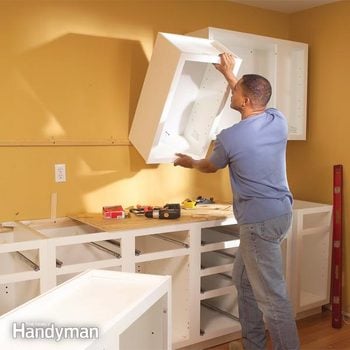
Install kitchen cabinets—base, wall and peninsula—using professional techniques. Hanging cabinets is piece of cake and you'll save on your next kitchen remodel.
You might also like: TBD
- Time
- Complexity
- Price
- A total day
- Intermediate
- Less than $20
Learn how to build your ain custom kitchen cabinets without the custom price: Check out How to Build Kitchen Cabinets taught past Steve Maxwell!
How to Install Kitchen Cabinets Step 1: Order the cabinets and assemble cardinal tools and materials
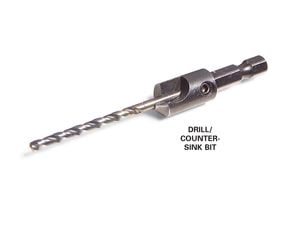
Special combination drill bit
This special fleck saves fourth dimension because it bores a pilot hole for the spiral and a countersink hole for the screw head.
Learning how to install kitchen cabinets may seem intimidating, simply the techniques are actually quite simple. Remember of information technology equally screwing a series of boxes to the wall and to ane some other in the proper sequence. If your cabinet plan is correct, your principal task is to find the all-time starting point and keep everything level. In this story we'll show you how to install kitchen cabinets and principal these central steps. Nosotros'll tell you how to lay out the cabinet positions ahead of fourth dimension to avoid missteps. Then nosotros'll show you how to install the base cabinets so they're perfectly aligned and set up to exist measured for the new countertop. Final, we'll testify you a simple method for installing the upper wall cabinets. The entire how to install kitchen cabinets project typically takes less than a day. And depending on how large and elaborate your kitchen is, you lot'll save at to the lowest degree $500 (and probably much more) in installation charges.
You only need a few basic tools to do a first-class chore. You'll demand an accurate 4-ft. level, a screw gun powerful plenty to drive 2-1/2-in. screws and a couple of good screw clamps that open up to at to the lowest degree 8 in. Buy a 1/8-in. combination drill/countersink bit for predrilling the spiral holes. Y'all'll too demand a block plane or belt sander for fine tuning the cuts to fit. A ane-lb. box of 2-i/2-in. screws and three bundles of shims will be enough for virtually any kitchen full of cabinets.
Make sure yous have the correct cabinets
The cabinets shown are chosen "face frame" cabinets, meaning they accept a 3/4-in.- thick frame surrounding the front of the cabinet box. "European" way (also called "frameless") cabinets are elementary boxes without the face frame, and they crave a few special installation steps that we won't embrace in this commodity.
We won't cover planning and ordering your cabinets here either. Just almost any home heart or lumberyard that sells factory-built cabinets will help yous custom-design your kitchen cabinet layout. All the staff needs is a drawing of your existing kitchen floor programme complete with exact appliance locations and room dimensions. But before yous finalize the guild, closely examine the computer screen and/or printout to make certain doors swing the right direction, end cabinets have finished panels on the ends, and toe-kick boards (1/4-in.-thick strips of finished woods for trimming cabinet bases) and filler strips are included. We highly recommend that yous order at least two extra filler strips for backups in case of miscuts. Go on a copy of the printout; you'll demand it to guide your installation.
When your cabinets make it, open up up the boxes immediately and confirm that each chiffonier matches the i on the plan, all the parts are included and in that location's no damage. A single mistake can delay the entire project. In our order, i cabinet was 6 in. undersized, the toe-kick trim boards were missing and ii of the cabinets were seriously damaged. Believe me, information technology happens!
Side by side, check out some trending kitchen cabinet paint colors that will make a splash.
How to Install Kitchen Cabinets Step two: Base of operations cabinets: Set the cabinet height and cabinet order
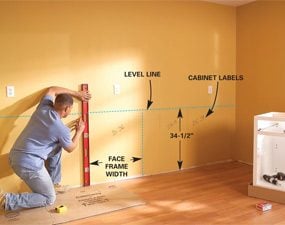
Kitchen Floor Cabinets Photo one: Mark the cabinet acme
Draw a level line on the wall 34-1/2 in. above the highest spot on the floor. Draw vertical lines to mark each cabinet location, characterization each cabinet's position on the wall and find and mark the studs.
Notice the highest spot on the floor
Most kitchen floors are very flat, especially in homes less than 40 years erstwhile. But before installing cabinets, it's always best to confirm that by looking for the highest spot on the flooring anywhere a cabinet will sit. You'll measure out up from that spot and draw a level line to define the top of all of the base cabinets (Photo one).
Observe that spot with a straight viii-ft.- long 2×4 (or shorter to fit between the end walls if needed) and a iv-ft. level. Residue the 2×4 with the level on top about 1 ft. away and parallel to the wall and shim the 2×four until it'due south level. Then mark the highest spot on the flooring and repeat well-nigh whatever other walls that'll have cabinets. Continue until you find the highest spot. If yous take two high spots, residual the board on both and find the highest one. Measure out up the wall behind that spot exactly 34-1/2 in. (standard chiffonier height) and mark the wall at that point. Using that marking equally a starting signal, describe a level line along the walls wherever base cabinets are planned (Photo ane).
Test-fit the base cabinets
In virtually cases, the corner cabinets determine where the residual of the cabinets go. That's especially truthful with lazy Susan corner cabinets, which have face frames facing two directions and have to meet adjoining cabinets perfectly. Our kitchen's "blind-corner" cabinets (Photo 2) are a bit more forgiving. Check your cabinet layout by "dry-fitting" all the base cabinets, starting with the corner ones, and setting all the cabinets in identify as tightly together as possible. If the layout calls for filler strips, make sure to exit spaces for those, too. With the cabinets in identify, check to make sure drawers and doors clear one another, appliance openings are the proper widths and sink bases centre under windows above. Unless your cabinet plan is flawed, whatever adjustments you lot'll demand to make are just a matter of ripping filler strips narrower or using wider ones. Next, remove the shelves, drawers and doors and mark them and their matching cabinets with numbered masking tape to save time and confusion subsequently. Then movement the cabinets out of the room.
Starting with the corner cabinets, carefully measure, draw and label each base cabinet and apparatus location on the wall. Use a 4-ft. level and a pencil (Photograph 1). The marks should reflect the width of the face frame, non the chiffonier dorsum. (The cabinet back is actually 1/ii in. narrower than the front, i/four in. on each side.) Utilize a stud finder or probe with nails to find and mark the stud locations just above the horizontal leveling line.
How to Install Kitchen Cabinets Pace 3: Kitchen base cabinets: Level and set up the boxes
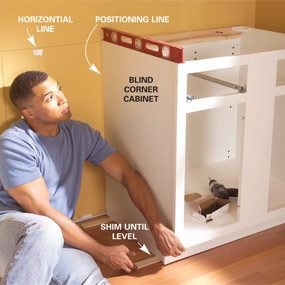
Kitchen Floor Cabinets Photo ii: Position the starting time cabinet
Set the kickoff chiffonier 1/iv in. from the positioning line and shim the base until the summit is even with the horizontal line and level from front to back. Drive two-1/ii-in. screws through the dorsum into the wall studs to ballast it.
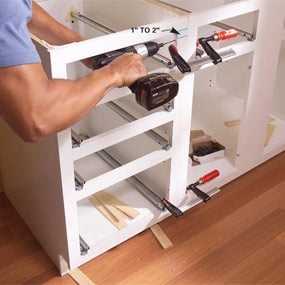
Kitchen Flooring Cabinets Photo 3: Spiral face frames together
Shim the adjacent cabinet even with the horizontal line and level information technology. Clamp the frames together, drill 1/8-in. pilot holes, and screw the frames together with two-ane/ii- in. screws. Then spiral the cabinet to the wall studs.
Position the corner cabinets 1/4 in. away from the vertical positioning lines. Shim the base until the chiffonier top is even with the horizontal leveling line then level and shim the chiffonier front to dorsum (Photo two). If at that place'southward a gap between the wall and the chiffonier back (the wall isn't exactly plumb or straight), slip in shims and run screws into the studs through the chiffonier dorsum about 1 in. down from the top (encounter Photograph 8). Later on all the base cabinets are prepare, score the shims with a utility knife and snap them off fifty-fifty with the cabinet top.
Position, level and shim the next chiffonier and clamp it to the beginning cabinet (Photograph 3). Run your fingers over the joint and you'll exist able to feel if it'south misaligned. Loosen each clamp one at a time and tweak the chiffonier frames until they're perfectly flush, so retighten the clamp. Exist fussy! Sometimes you'll have to loosen the screws holding the previous cabinet against the wall and pull it away slightly to get the frames aligned. When you lot're satisfied, drill pilot holes through the frames one to 2 in. from the tiptop and bottom of the cabinet interior.
Make sure you lot're drilling straight. The nigh common mistake is to run the chip through the front of the cabinet frame! With the face-frame screws in place, remove the clamps and screw the cabinet to the wall. Echo the same process for each consecutive cabinet.
How to Install Kitchen Cabinets Pace 4: Base cabinets: Add filler strips
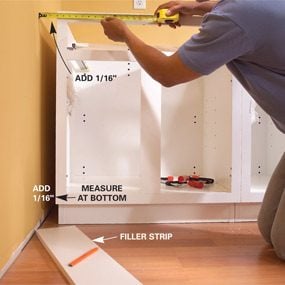
Kitchen Floor Cabinets Photograph 4: Mensurate the gap
Measure out the gap between the wall and the end cabinets at the top and lesser. Add one/xvi in. to each measurement and depict a cutting line on the backside of a filler strip.
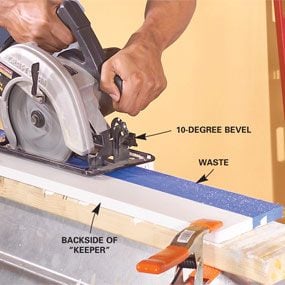
Kitchen Flooring Cabinets Photo five: Cut the filler strip
Clamp the filler strip and cut it at a 10-degree bevel from the behind and so the broad border of the "keeper" piece faces the front.
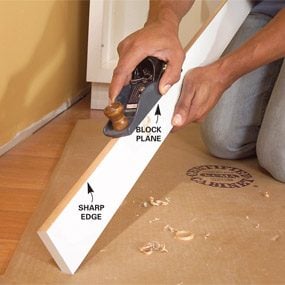
Kitchen Floor Cabinets Photograph six: Fit and install the filler
Exam-fit the filler strip and plane the sharp edge of the bevel until it fits perfectly. Ready the strip in identify, predrill and screw it to the cabinet frame.
Add filler strips wherever the cabinets come up upward short of walls as we show in Photos 4 – 6 or wherever the plan calls for them. Go out the right gaps for appliances. Some built-in appliances like dishwashers require very exact openings.
All manufacturers offer filler strips to match the woods type and finish of their cabinets. Generally they'll offering widths about 3, half-dozen and eight in. cut in the same lengths as the tiptop of the chiffonier face up frames. They fill spaces betwixt end cabinets and walls, create additional spaces between cabinets or between cabinets and appliances for drawers and doors to clear, and shut upwardly odd gaps (Photograph 4).
Spaces between cabinets and walls are rarely fifty-fifty, so you'll have to taper many filler strips. The best strategy when installing cabinets is to overcut slightly (1/sixteen in.), then plane or belt-sand the border back. The 10-degree bevel simplifies this process (Photos 5 and half-dozen). If you accept a large slice left over, protect the surface with masking record as we bear witness and use information technology elsewhere. You won't be able to clench filler strips when they're against walls, and then fit them tightly to make drilling and screwing them to the cabinet easier. Fillers that are less than 6 in. broad can "float" against the wall and need no back up. Just fillers more than than 6 in. wide should be supported. Nail them to a 1×2 capitalist board that'south glued to the drywall directly behind the filler.
How to Install Kitchen Cabinets Step five: Base cabinets: Make plumbing and electric cutouts
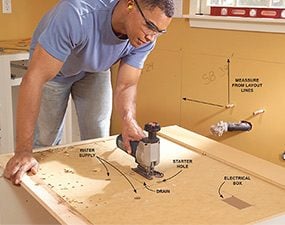
Kitchen Floor Cabinets Photo vii: Cutting plumbing openings
Lay out plumbing and electrical openings on the cabinet back, using the layout lines on the wall as reference points. Then drill and/or saw out the openings.
You'll probably have to cut openings for the drain and water supply lines and for outlets (Photo 7). Lay out the openings by measuring from the layout lines at the summit and side, then transfer those numbers to the back of the cabinet. To avoid confusion, practise the layout work with the cabinet virtually its position and in the correct orientation. Drill holes for water supply lines and starter holes for square openings with a one-in. spade bit. Stop drilling when the tip just penetrates the back, and end the holes from the inside of the cabinet to forbid splintering the cabinet interior. Cut square openings with a jigsaw. If your drain line projects from the wall at an angle, simply cut a rectangular hole around it as nosotros did.
How to Install Kitchen Cabinets Footstep half dozen: Set the peninsula cabinets
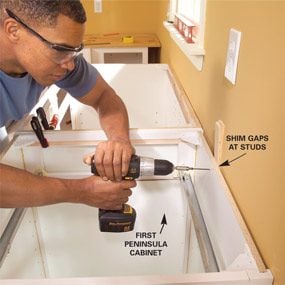
Kitchen Floor Cabinets Photo 8: Set the kickoff peninsula chiffonier
Orient the first peninsula cabinet at a right angle to the wall. Level and clamp it to the adjacent cabinet and spiral it to the cabinet and the wall.
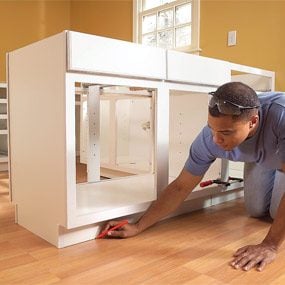
Kitchen Floor Cabinets Photo 9: Marking the position of the second cabinet
Position the next chiffonier in line, clamp it and draw a line around the base. Make certain it's at a right angle to the other base of operations cabinets. Gear up the cabinet aside.

Kitchen Floor Cabinets Photo 10: Install two x 2 support
Draw a second line to mark the thickness of the cabinet base, then screw 2x2s to the floor along the inner line.
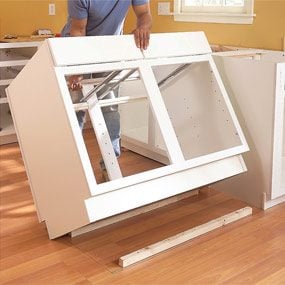
Kitchen Floor Cabinets Photo eleven: Set the cabinet
Lower the cabinet over the blocking. Shim, clench and screw the frames together. Screw the cabinet to the blocking with two screws from each side.
Level and screw the first peninsula chiffonier to the adjoining standard base cabinet. You'll probably take to fill a i/4-in. gap with shims before screwing it to the wall studs (Photograph 8). If the first peninsula cabinet is simply 2 ft. broad, y'all may have to clamp and screw filler strips to the frame so doors and drawers in the next chiffonier will have operating clearance at the inside corner. This should exist marked on your plan.
After the get-go peninsula cabinet is in place, anchor the cabinets that follow to permanent blocks on the floor. To do that, position the side by side peninsula chiffonier and outline its base on the floor with a pencil (Photo 9). Then screw ii-by blocking to the floor subsequently allowing for the cabinet base thickness (Photograph 10). Don't try to place or cut the blocks perfectly. They tin be brusque of the cabinet end past a couple of inches and back from the within of the chiffonier 1/8 in. or and so. That fashion you won't take to struggle to fit the cabinet over the blocks. Screw the blocks into the subfloor with 2-one/2-in. screws spaced about every foot. Set the cabinet into place, level it with shims, then clamp and screw it to the neighboring cabinet and into the blocking.
Anchor island cabinets using the same positioning and blocking techniques we show for the peninsula cabinets. However, it'southward all-time to install your upper cabinets before starting on an island to keep a clear piece of work expanse in the middle of the kitchen.
How to Install Kitchen Cabinets Step vii: Install the upper cabinets
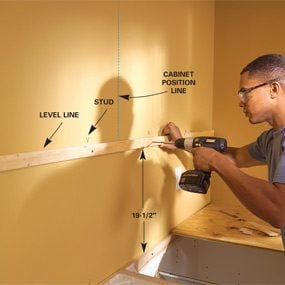
Kitchen Floor Cabinets Photograph 12: Mark the chiffonier positions
Draw a level line nineteen-one/ii in. to a higher place the lower cabinets and mark the upper cabinet positions. Screw a 1×ii ledger to the wall even with the level line.
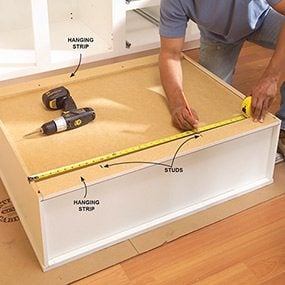
Kitchen Floor Cabinets Photograph 13: Marker stud locations
Measure from the cabinet position lines to the stud locations. Mark the stud locations on the cabinet backs and drill 1/8-in. pilot holes through the hanging strips.
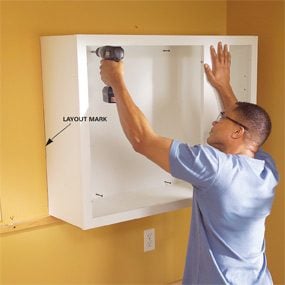
Kitchen Floor Cabinets Photo fourteen: Screw the cabinets to the wall
Start 2-1/2-in. screws, and then rest the cabinet on the ledger. Align it with the chiffonier position line and drive the screws into the wall studs.
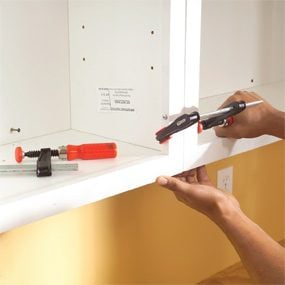
Kitchen Flooring Cabinets Photo xv: Hang additional cabinets
Position the side by side cabinet and run the top screws partially into the studs to hold information technology in place. Marshal the frames, clench them and spiral the cabinets together. Then screw the chiffonier to the wall.
The just tricky part about installing hanging upper cabinets is supporting them in exactly the right position while you screw them to the wall and one another. That's a tough, bad-mannered job, especially if y'all're working lonely. The ledger method simplifies this (Photo 12). Information technology'southward a neglect-safe method, but y'all'll have to accept a bit of patching and paint retouching to repair the screw holes left from the ledger.
Showtime past making a light pencil marking nineteen-1/two in. up from the lower cabinets (information technology'll exist 18 in. after the countertop is installed) and so mark the stud locations using the ones below every bit a guide. Next, transfer the cabinet positioning lines from below (Photo 12) and screw a i×2 ledger to the studs even with the layout lines. It's all-time to prestart the chiffonier screws before hoisting the cabinets upwardly onto the ledger. Photo 13 shows an like shooting fish in a barrel method to go the screws in the right identify using the chiffonier positioning lines and the stud locations on the wall and then transferring them to the cabinet. Y'all'll ofttimes find that a chiffonier, especially a narrow ane, volition have simply one stud behind it. Don't worry; the other cabinets will help support it also.
Commencement any corner cabinets first. Space the offset cease cabinet exactly i/four in. away from the layout line and screw it to the wall. Be exact with the commencement cabinet considering information technology will define the locations of all the residuum of the cabinets on that wall.
Start the screws and hoist the next cabinet into identify, snugging its frame against the neighboring one, and screw it to the wall. Adjacent, align the frames and clamp them together every bit you did with the base cabinets (Photo xv). You'll probably have to back out the stud screws slightly in i or both cabinets to get the frames to line up perfectly. That'south fine—leave the screws backed out while you clamp, drill and spiral the frames together.
How to Install Kitchen Cabinets Step 8: Terminate with doors and trim
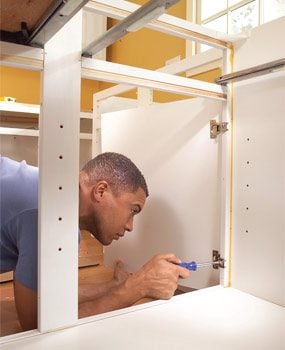
Kitchen Floor Cabinets Photo 16: Install cabinet doors
Replace the drawers, then rehang the doors and conform the hinges to align the doors with one another.
Stop off the cabinets past cutting, plumbing fixtures and nailing the toe-kick boards to the bases. They'll exist 4 in. wide, only on irregular floors, y'all may need to rip them narrower to go them to fit. If you have bad gaps between the floor and the toe-kicks, add base shoe contoured to fit the floor. Wherever cabinets have finished ends, run the toe-kick boards 1/4 in. past the cabinet for a nice appearance. Finish up by slipping the drawers into their slides and reattaching the doors (Photo xvi). Adjust the hinges until the doors line upward perfectly, and move on to installing the door and drawer pulls.
Editor's Note: Complete Repairs and Painting Before Starting How to Install Kitchen Cabinets Projection
After your old cabinets are torn out, and before learning how to install kitchen cabinets, is the perfect time to exercise any kitchen improvements. Here are some upgrades to consider:
- Electrical upgrades. Older kitchens are notorious for lacking adequate lighting and outlets. Consider calculation undercabinet, task or indirect lighting and more outlets and upgrading all the outlets to GFCI-protected ones (now demanded by code). It'due south easy to cut open drywall, fish new wires and install electrical boxes because y'all can do the piece of work behind the cabinets. Repairs won't have to exist perfect because they won't testify.
- Drywall repair. Patch any holes or any other drywall harm.
- Painting. Repaint all of the walls and the ceiling. Yous'll save the hassle of cutting in around the new cabinets and go a much neater job to boot. You can touch on upwardly nicks and bumps afterward.
- Install new finished flooring if you can. Most finished floor materials can be installed ahead of the cabinets. That's much easier to practice considering y'all tin can project the flooring under the cabinets and avoid cutting around them afterwards. Hardwood flooring, tile, near vinyl and some laminate floors tin handle cabinets resting on them with no problem. But exist conscientious. Perimeter-glued vinyl and floating wood laminate floors demand to expand and contract freely. If you rest cabinets on them, yous may have issues with buckling, splitting or cracking later.
Required Tools for this How to Install Kitchen Cabinets Projection
Have the necessary tools for this how to install kitchen cabinets DIY project and other kitchen cabinet projects lined up before you lot showtime—you'll salve fourth dimension and frustration.
Required Materials for this How to Install Kitchen Cabinets Project
Avert last-minute shopping trips by having all your materials ready ahead of time for this how to install kitchen cabinets project. Here's a list.

Source: https://www.familyhandyman.com/project/installing-kitchen-cabinets/
Posted by: dickermanfrivelly.blogspot.com
0 Response to "How To Install Bottom Cabinets"
Post a Comment